


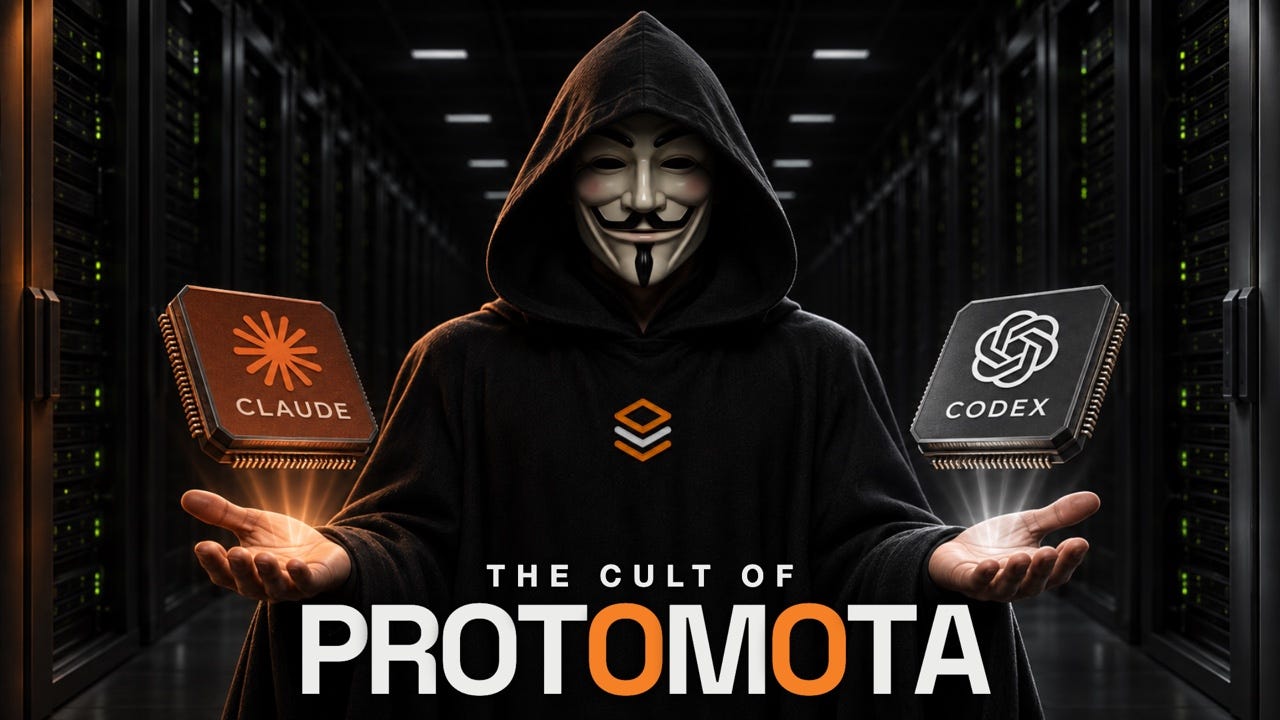
We are The Cult of Protomota. We’re here to help people find work in a world changed by AI. We learn new ways to work so we can find meaning in what we do and take pride in doing it well.
Watch the manifesto on YouTube
We are a way of life, and it starts with how we think and how we work. We pay attention. We question what we’ve been told. We figure out what actually matters and take responsibility for what we do about it.
It feels like bots have taken over much of the internet. Some people act like bots, too. That’s one reason we built the Cult of Protomota. We wanted a place where people can share what they’re building and help each other find work that matters.
We want the cult to be a place where we help each other build skills that matter for the future. We go looking for opportunities and find more than we can take on. We focus on the ones that can help someone or teach us something useful. Before we give a weekend to a hobby or side project, we look for something it can teach us or something we can finish. Follow the cult. We will show you where the opportunities are.
We design and build software and use AI and automation to take repetitive work off our plates. The tools will change. How we think about what’s worth doing matters more than anything we build.
We work at the speed of AI. We believe in agency. We try new things and take on challenges we’ve never faced before. We learn what we need as we go. We choose a problem, put our own idea to the test, and get started without waiting for permission. We blaze our own trail. Some would say we think different.
Looking for work can be hard, especially when housing and insurance take up more of the budget. We can make things a little easier for each other. Sometimes that means passing along a lead or helping someone build a skill they can use.
Some of us learned in college. Others learned on the job or taught themselves. We value what you can do with what you know, and a willingness to learn matters just as much. If you’re just starting out, changing careers, or thinking about making a change, you’re welcome here. Learning how to learn will serve you long after the work changes.
An interview goes both ways. We’re interviewing the people offering the opportunity just as much as they’re interviewing us. We pay attention to how they work and how they treat people.
We block off time for work that takes a clear head. Email and group chats can wait until we come up for air. If a status update fits in a note, we send a note. When we do need a meeting, we leave knowing who’s doing what next.
Steve Jobs put it simply at Apple’s 1997 developer conference. “Focus is about saying no.” We aim for 80% signal, 20% noise, in that order. We choose where to put our time by looking at who the work helps and what gets better when we do it. Watch Steve Jobs at WWDC
We’ll pivot ten times in a single day if that’s what it takes. When the work stops helping the person we set out to help, we change course.
Above all else, we protect our signal. We give the work that matters our best hours. We build projects that you can see and use. That might be a feature you can try today, a video that walks you through a tricky step, or an article that helps you understand what happened and why.
We used to hand a design to an engineer to build. Now a designer or a product owner can put one agent to work on the screen and another on the data behind it. We need to become expert agent orchestrators. That means knowing how to divide the work, what each agent needs from the others, and how to tell whether the pieces work together. In the future we’re building, we’re all engineers.
If you tried AI and didn’t like the output, try it again. Then keep trying it. We test the best models we can get our hands on, including the ones we can run locally. We give them real work and push them until they break so we know where they’re useful and where we still need to take over.
Explore tools you can practice with on a project of your own. Look for a team that shares your values and gives you room to grow.
Once the work is done, the other 20% is ours. We spend time with family and pets or just take it easy.
We keep the subscriptions and feeds we use and make room for things we want to learn next.
If you’ve been watching videos about how to build an app, pick one idea and open an editor. Start with one small thing you want the app to do. Trying it yourself shows you what to learn next, and you’ll have something you can build on tomorrow.
We put in the hours. A thousand, ten thousand, however many it takes.
We use AI to make ourselves more intelligent and to take big ideas further. If we borrow an idea, we reinvent it. Let somebody else do it first. Then do it better. Apple did that with the iPhone. It put a phone, an iPod, and the web behind one touchscreen.
We teach ourselves. We use AI to find our own answers, check what it tells us, and put what we learn to work.
We build on the basics by learning to design systems that hold up, track down a tough bug, and check an AI answer against the facts. We try tools on real work before we pay for them. A tool earns its place when it makes the job easier or improves what we make.
We give our own work the same care. We use a lot of software and study the best work we can find on design sites. AI lets us try a few versions of an interface while the idea is fresh. We learn the most when we try to get something done with it and notice where we hesitate.
We make time for creators who teach us something we can put to work. As our interests and skills change, we update what we follow so there’s room to discover someone new.
We believe in common sense and street smarts, and we work at both. We pay attention, get our hands dirty, and see what actually works. When we hear “that’s how we’ve always done it,” we look at what the old way still does well and what we’d change today.
We want control over the tools we build with, so we back open source and models we can download and run on our own hardware. That’s what I like about what teams in China are doing with DeepSeek and Qwen. Google deserves credit for releasing Gemma, and Meta gets credit for making Llama’s weights available. DeepSeek · Qwen · Gemma · Llama
We build apps for ourselves and share them with anyone who needs them. If a screen is confusing or a task takes too many clicks, we run into it the next time we open the app.
We build software in a dark factory. We use the best frontier models available to work through architecture decisions and review our code.
We give the agents a clear goal and tell them what success looks like. We bring a working build to the first design discussion so we can point to the part that needs to change.
We use agents for QA, too. They go through the app like a user would and try to break it. When they find a bug, they write a regression test, fix the bug, and rerun the suite.
Our agents use the desktop and browser directly. We set the boundaries and give it full access inside that working environment. We leave our desktops on so the work keeps going when we step away.
Building software we use every day has made us pickier about the tools we rely on. What we like about the Apple ecosystem is how easily we can pick up our work on another device. We can copy a link on an iPhone and paste it on a Mac, AirDrop a file to an iPad, or use Handoff to finish an email we started on the phone. We want that same ease from Protomota apps. Open one on the device you have with you and get straight to work. Apple’s Continuity features
That’s why we build Mac-native software and make apps for iPhone, iPad, and Apple Vision Pro. We build in Swift and use iCloud to sync across Apple devices. Native software is coming back. We used to reach for the web when we wanted one app to run on every device. Now we can share code across Apple devices and build native apps for each one.
We use Claude and Codex because they help us get work done. We love building for the Mac. We choose the tools that serve the work and share what we learn along the way.
We believe the future of software belongs to independent developers. When an indie app looks useful, we give it a chance and try it on real work. Software artisans are making a comeback. A small team or even one person can now build and ship what used to take a whole company.
We give people the whole app for free. We make the source code freely available. Download it, open it, use it. No ads. No app login. No paywall. No mandatory SaaS subscriptions. No API key to dig up. No license key to activate. No counting how many computers you’re allowed to use.
We build MCP connectors so you can use the AI agent you choose and decide what data it can access. If a task would send you digging through docs or clicking through menus, you can tell the agent what you want done and let it handle the steps.
Your data stays local. You can export it, use your own scripts to back it up to a cloud account you control, and restore it when you need it. You decide what leaves your machine and who gets a copy.
We accept donations in the form of tips to support continued development and to support the cause. If the app makes your life easier and you want to give, you can donate once or choose to give monthly. If you can’t pay anything, you still get the whole app. The work has to earn your support.
We want people in education, people going through hard times, and people who just need a way to get started to have the same tools as the people who can afford them. Adobe’s full Creative Cloud Pro suite costs $69.99 a month in the U.S. with a year-long commitment, or $104.99 if you go month to month. If you can’t swing that or even $20 a month for another SaaS tool, you should still be able to do the work. That’s why we’re rooting for our brothers over at ArtCraft, who are building free, open-source tools for photo editing, vector illustration, and video editing. We’re rooting for everyone else who shares their source code or gives people a free app they can actually finish a project with. Adobe pricing · ArtCraft’s creative apps
The best way to judge a free app is to try it on something you care about. If it helps, share it with someone else who could use it.
Every time someone recommends an independent app, another person gets a chance to discover it. We rely on the people who use our apps and tell others about them. That’s how a small project finds its audience.
We never run ads in our YouTube videos, in our apps, or on our websites. We never take on sponsors. We’d only endorse a company that lives up to our ideals in how it builds its products and runs its business. It has to give back to the community and do work that makes people’s lives better.
I endorse companies for free. They earn an endorsement by living up to those standards. I accept donations, and that support helps me feed my family. It might also give me time to review your product. If I do, I’ll tell people how it held up in my own work.
That’s the point of the cult: get better at the work we care about and share what we learn. If someone leaves with a skill they can use or a tool that makes their day easier, we’ve done something worthwhile. We’ll keep the noise down and leave each other room to do the work.
We share the solutions that work for us. Take what helps and make it your own. Follow along or go your own way. We have a dark sense of humor, and we can laugh at ourselves.
The cult won’t have a weekly meeting. We’ve got shit to ship.
I might turn it into a proper religion, though. The tax benefits are tempting.
To join The Cult of Protomota, come find us on Discord. For updates, subscribe to Protomota Lab.
If we ever have to start from scratch, we’ll build our way back up together. We’ll rise from the ashes. We are the Cult of Protomota.
May superintelligence have mercy on your soul.