

If you are a builder looking for AI hype, this is not for you. I am talking to the people trying to create a way out while the game in front of them keeps getting harder to play. While I don’t want to discourage, I feel it is important to be honest. AI was supposed to lower the barrier. Instead, it lowered the barrier for everyone at once, flooded the field, and made attention even harder to earn. The rules no longer make sense, and I do not have a clean set of answers. What I can do is paint a picture as honestly as I can.
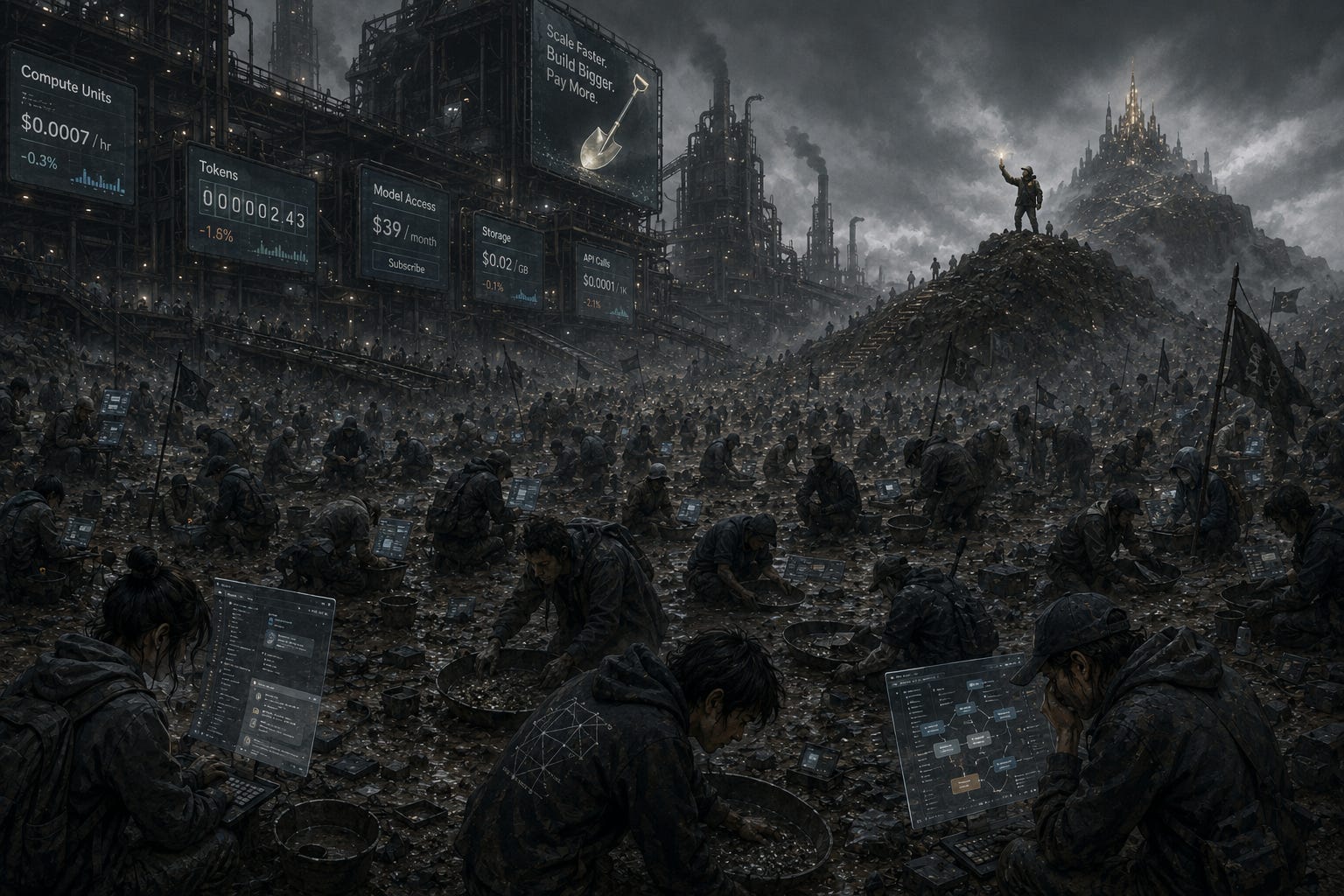
A lot of people feel the vortex pulling them toward the permanent underclass, so they are frantically trying to build their way out. I wish the outlook were better, but I am not here to feed the algorithms with AI hype and hustle fantasy. I would rather tell the truth plainly: the escape hatch is getting crowded, the odds are brutal, and the easy answers have left out the hard parts.
This is not about one failed idea or one side project that did not work. It is about reaching the point where years of effort start to feel like they have been fed into the wrong machine. I have tried enough ideas over the years to know that effort, creativity, and the ability to build are not always the missing pieces. The soul-crushing part is getting attention and traction in a world where building the thing is no longer the same as getting anyone to care. The playbook now is posting constantly, performing confidence, chasing trends, and packaging yourself for strangers, until the person you are presenting starts to feel less and less like you.
And it is not like the traditional path feels safe anymore. The tech job market has changed. Layoffs, AI automation, shrinking teams, fierce competition, lower offers, and higher expectations make the ground feel less secure than ever. When the path that was supposed to be safe starts looking unstable too, it all leads me to the same question, if I can quote the great Axl Rose: "Where do we go now?"
At work, AI and automation are already threatening jobs, compressing teams, and forcing the people who remain to produce more while wondering how secure their next paycheck really is. Once businesses believe the cost of computer work is going down, they start expecting more output for the same money. And with a hundred qualified candidates lined up for the same job, the employer has the upper hand. AI was supposed to make work easier, but ask around in tech and I think you will struggle to find many people who feel like their job actually got easier. For a lot of people, it just frees them up to be handed more work, or pushes them out of a job entirely.
AI is also lowering the perceived value of engineers, analysts, consultants, designers, and other computer-based workers. After enough rejected job applications, lowball offers, or quiet signals that your work is suddenly worth less, a lot of people start looking online for another way out. They chase side hustles, SaaS ideas, digital products, consulting offers, affiliate funnels, creator businesses, and anything else that promises income outside the traditional job market. But those lanes are already saturated too. Everyone is being pushed toward the same escape hatch at the exact moment that escape hatch is filling up.
And even the attempt to escape has a price of admission.
First there is the learning curve. Before anyone makes a dollar, they have to spend a lot of time, and sometimes money, figuring out the tools, the market, the platform, the content game, the sales process, and whatever new thing everyone says they need to know this week. Keeping up with AI can feel like a full-time job by itself, because the tools, workflows, and so-called best practices keep changing faster than most people can reasonably absorb.
Then there are the AI subscriptions. That is the hype pulling people into the game. AI makes creation feel almost too easy. You can spin up prototypes, landing pages, workflows, agents, demos, digital products, and code faster than ever before. The pitch is simple: the tools are here, the barriers are gone, and now anyone can build the thing they have been dreaming about.
But AI did not democratize success. It democratized production. For most of software history, the market depended on a lot of people using what a smaller group of people built. Those users were the market. Now the pitch is that anyone can build, so the people who used to be potential customers are trying it themselves. Cue the Spider-Man pointing at Spider-Man meme, except every Spider-Man has a SaaS product.
The part I do not buy is the idea that the appetite for software is limitless. A lot of productivity and utility software starts to look less like a durable product and more like a temporary workaround when an agent can do the task directly, spin up a script, or create a reusable skill without needing a standalone app at all. Everyone is being pushed to build, ship, automate, post, and launch at the same time, even as the layer they were going to sell keeps disappearing into the agent. There are only so many jobs inside the AI labs working on the next agent harness or LLM.
That is the part the AI hype machine does not want to say out loud. The tools create a flood of output, but the value of each individual output keeps falling. The number of builders exploded. The number of people with time, attention, money, and actual need did not explode with it. Meanwhile, the amount of content and software on the internet keeps growing because AI lowers the cost of producing more of it. Every new trick for generating automated slop makes the pile bigger and the attention problem worse.
A product with no users is not a business. It is a hobby until someone else cares enough to make it more than that. But even success creates a new problem. The second you show traction, you become a target for copycats, and now those copycats can be spun up in a weekend. The lane floods, the value gets diluted, and the old moats stop holding water. Either way, every prompt, prototype, agent, demo, copycat, and failed growth experiment still feeds the meter one inference token at a time.
And if you are building applications, the meter does not stop with tokens. There is also the SaaS layer, the middle layer between the dream and the customer. Before you even have a real business, you are paying for the permission to attempt one: hosting, databases, domains, email, storage, analytics, monitoring, payment processing, deployment tools, support chat, CRMs, CDNs, vector databases, and whatever else promises to save you from building one more piece yourself. Each tool may be reasonable on its own. Together they become monthly toll booths between you and the possibility of profit.
Then comes the attention layer, where the gold rush stops feeling romantic. In the age of AI, building is easier than ever. Getting noticed is the hard part. Finding a real customer can feel like striking gold after months of sifting through dirt. You can pour time, skill, money, hope, and pieces of your life into something, and still end up panning a dry creek while the people selling the shovels get paid either way.
That is why the gold rush analogy fits. Some people will win. Some people have the right talent, timing, network, audience, money, credibility, or platform access. Others simply get lucky in a way that changes everything. I am not saying the winners did nothing right. I am saying the path keeps narrowing for everyone who does not already have some combination of those advantages. The algorithms show us the winners, not the graveyard of people who tried, failed, and quietly disappeared from view.
The cruel part is that even when someone does find traction, they may still be building on land they do not control. Someone else owns the model, the platform, the pricing, and the roadmap. During the hype cycle, that can look like a shortcut. In reality, the ground can move underneath them at any time. A startup can spend months packaging a workflow and teaching customers to care, only for a major lab or platform company to fold the same idea into the base product. Sooner or later, it starts to feel like we are all tenants in someone else’s AI empire, paying rent to the lab overlords for the privilege of building on land they can reclaim whenever they want.
All of this changes the emotional reward of building. Shipping used to feel like proof that you had skill, effort, and persistence. Now the internet is flooded with apps, tools, posts, products, and AI-generated everything. Building still matters, but it feels less meaningful when everyone can create more than anyone has time to notice, use, or value. The constraint was never just whether you could build the thing. It was whether someone needed it, whether they could find it, and whether the platforms would give it enough air to reach them. You can build something someone genuinely needs, but if they never find it, that need never turns into a customer, a sale, or even a chance. That is the situation I feel we are in: the zone is flooded, the noise is deafening, and the platforms are training people to move on before anything real has time to land.
This is the exhausting part. The thing I do not want to feed becomes the thing I am told I must feed if I want to survive. Package yourself. Put yourself on display. Turn thoughts into content, pain into engagement, personality into brand, and connection into metrics. I do not want to be a content creator. I want to build useful things and solve real problems. But the system keeps turning everything into a competition for attention, and it keeps saying the work is not enough unless I also become entertaining, visible, and algorithmically acceptable.
The competition is everywhere now. Jobs, housing, health care, status, attention, influence, relevance, all of it feels like a scoreboard that never turns off. AI is being poured into that same system, and instead of freeing people, it is raising the baseline. What used to be impressive becomes expected. What used to take a team becomes one person’s workload. What used to be enough becomes the bare minimum. It is tiring to live inside a world where every part of life feels like another arena you are supposed to win.
What feels morally rotten is how the system does not simply ask people to become better. It asks them to survive by comparison. It asks them to compete harder for a shrinking set of crumbs, then pretend the game is fair because a few people strike gold.
So what is the answer? More people in physical trade work? Again, is there a need for that? We can’t keep flooding our industries with overflows and calling that a solution. Besides robotics and automation is already coming for a lot of physical jobs too.
Look, the AI automation genie is not going back in the bottle. We are going to have to adapt to living with it. The problem is that it is being released into a world that is not built to absorb it humanely. It is being dropped into a system already organized around scarcity, competition, extraction, and constant comparison, so instead of making life easier, it keeps getting used to raise the baseline and squeeze people harder.
If you were hoping to find answers at the end of this, I am sorry. I do not think the answers most people are looking for are fully in our control. Too many of them sit with the architects of the machine: the people holding the purse strings, setting the incentives, writing the rules, and profiting from the machine as it exists. But that does not mean we do nothing, and it does not mean we give up. It means we keep trying with our eyes open. It means we stop pretending individual grit can fix something designed to squeeze people, but we still keep trying with a clear view of what we are up against.
Maybe purpose cannot come from trusting the machine to become humane on its own. Maybe it has to come from pushing for something better while building smaller, realer things that still matter to actual people. And yes, maybe survival means doing more of what we do not believe in than we would like. Maybe we still have to post, sell, package, and play parts of the game. But if we do, we should at least keep hold of our own judgment. Do not sell yourself out just to become easier for the algorithm to consume.
And maybe it means paying attention to the people being crushed by the same machine. If you are winning, good. I mean that. But look behind you once in a while with some empathy. Someone else may be struggling, not because they are lazy or stupid, but because they caught a different mix of luck, timing, health, money, family, network, personality, and circumstance. With a different hand, that person could be you.
That is why the goal cannot just be escaping alone. It has to include helping the next person find a way through too. If the machine was designed by people, it can be redesigned by people. So vote for people willing to redesign it for the public, not the architects already profiting from it. Then hold them accountable when they protect the machine instead of the people being crushed by it. The machine only stays untouchable if we keep treating it that way.